
Daily P&L – The True Measure of Apparel Retail Profitability
Most apparel retailers look at profit in one way: “I sold for ₹10 lakhs today, I purchased for ₹7 lakhs, so I earned ₹3 lakhs.”
But this calculation ignores the biggest truth in retail — profit is never what you see at first glance. Rent, salaries, advertising, depreciation, bank interest, and dozens of small daily expenses eat into the so-called profit until very little remains.
That’s why retailers need to compute a Daily P&L (Profit & Loss) that takes into account every rupee spent on running the store. This isn’t about justifying losses — it’s about seeing the real picture, making better decisions, and building a business that can scale.
Step 1: Start with Gross Margin
- Sold Value (Ex-GST) – Purchase Value (Ex-GST) = Gross Margin
- Deduct a nominal charges buffer (e.g., 1% of COGS for packaging, transport, misc. handling).
This is your first layer of profit before overheads.
Step 2: Allocate Fixed Costs Daily
- Employee Salary
- Total monthly salary ÷ working days = per day employee cost.
- Rent & Utilities
- Monthly rent + electricity + maintenance ÷ working days = per day rent cost.
- Marketing & Advertisement
- Define monthly/yearly budget, divide by working days = per day marketing spend.
- Daily Operating Expenses
- Small cash spends → unloading, refreshments, supplies.
- Weekly spends (e.g., Puja, Friday gifts) → divide across week to get daily equivalent.
Step 3: Consider Depreciation
Retail involves assets: vehicles, furniture, computers, warehouse racks, POS machines.
- Each has an annual depreciation %.
- Divide total depreciation by working days → per day depreciation cost.
Step 4: Don’t Forget Interest on Stock Investment
This is where most retailers go wrong. Stock isn’t free — it’s money locked in goods.
- Example: You have ₹5 crore worth of stock in your showroom.
- If this money was kept in a bank FD at 9% interest, it would earn ₹45 lakhs annually.
- That’s ~₹12,000 per day lost just by keeping stock instead of cash.
👉 So, interest on stock capital must be treated as an expense in P&L. This ensures you value stock rotation and cash flow properly.
Step 5: Consolidate Into Daily P&L
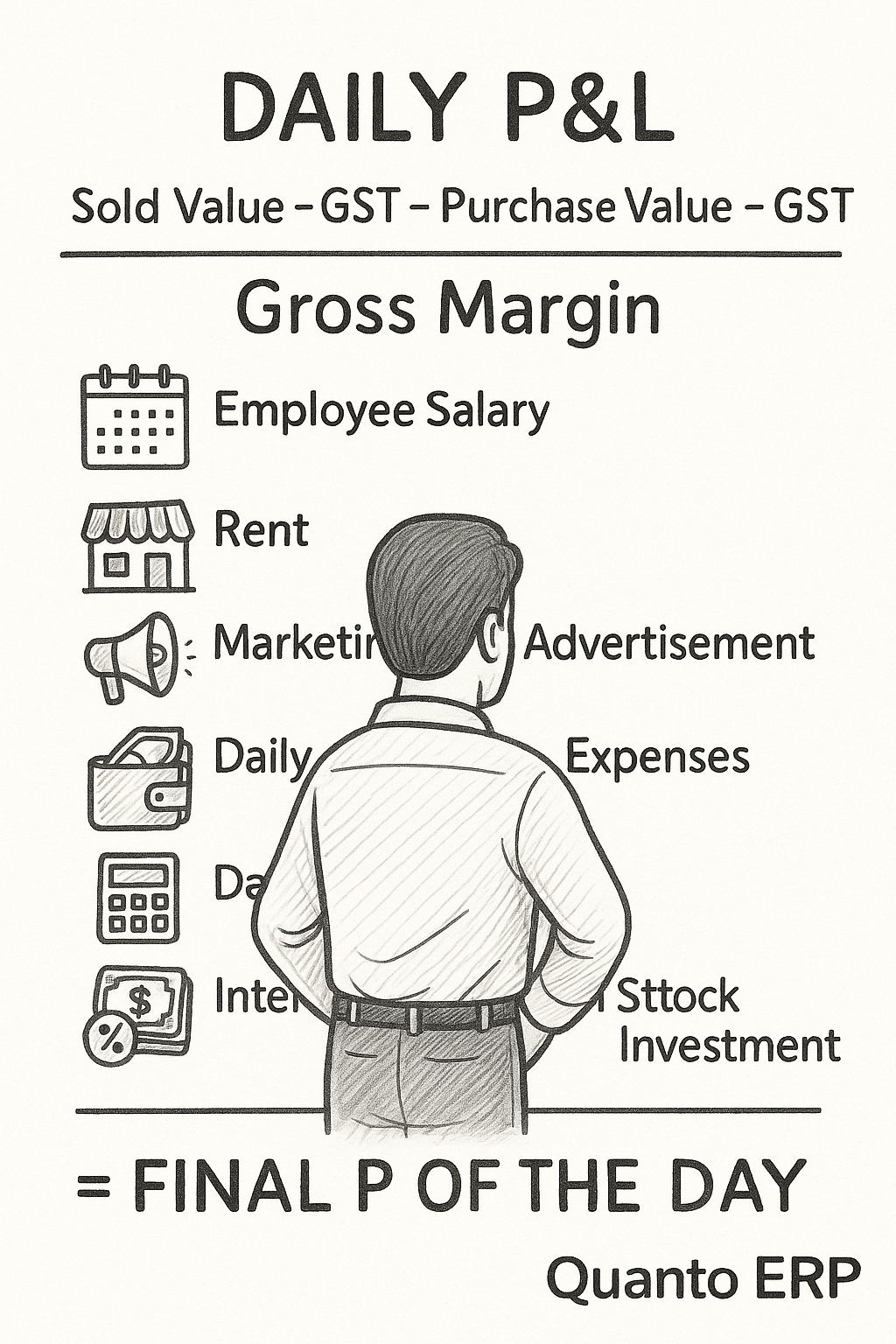
Your Daily P&L should look like this:
- Gross Margin (Sales – Purchases – Charges)
- – Employee Salary Cost (daily share)
- – Rent & Utilities (daily share)
- – Marketing & Advertising (daily share)
- – Daily Cash Expenses (actuals + weekly shares)
- – Depreciation (daily share)
- – Interest on Stock Capital (daily share)
= Final P (Profit) of the Day
This tells you the true profitability per day per store, not just the illusion created by sales.
Why This Matters
- Branch-Level Profitability: By distributing all expenses across branches, you know which store is genuinely profitable and which is leaking money.
- Better Decision-Making: Maybe one store looks busy but actually loses money after rent and salaries are factored. Another smaller store may be quietly more profitable.
- Capital Discipline: By treating stock as investment, you learn to rotate faster, avoid overbuying, and value liquidity.
- Investor-Ready Reporting: If you ever want funding or loans, a Daily P&L framework makes your business look professional and bankable.
🚀 Takeaway
Apparel retail isn’t about sales numbers — it’s about profit after every hidden cost. A Daily P&L transforms the way you look at your business.
👉 Without Daily P&L: You celebrate sales and miss losses.
👉 With Daily P&L: You celebrate true profits and fix leaks before they sink your store.
✨ End line: “Sales are vanity, margins are sanity, but only P&L is reality.”