
GST in the Apparel Industry – Challenges & Solutions Every Retailer Must Know
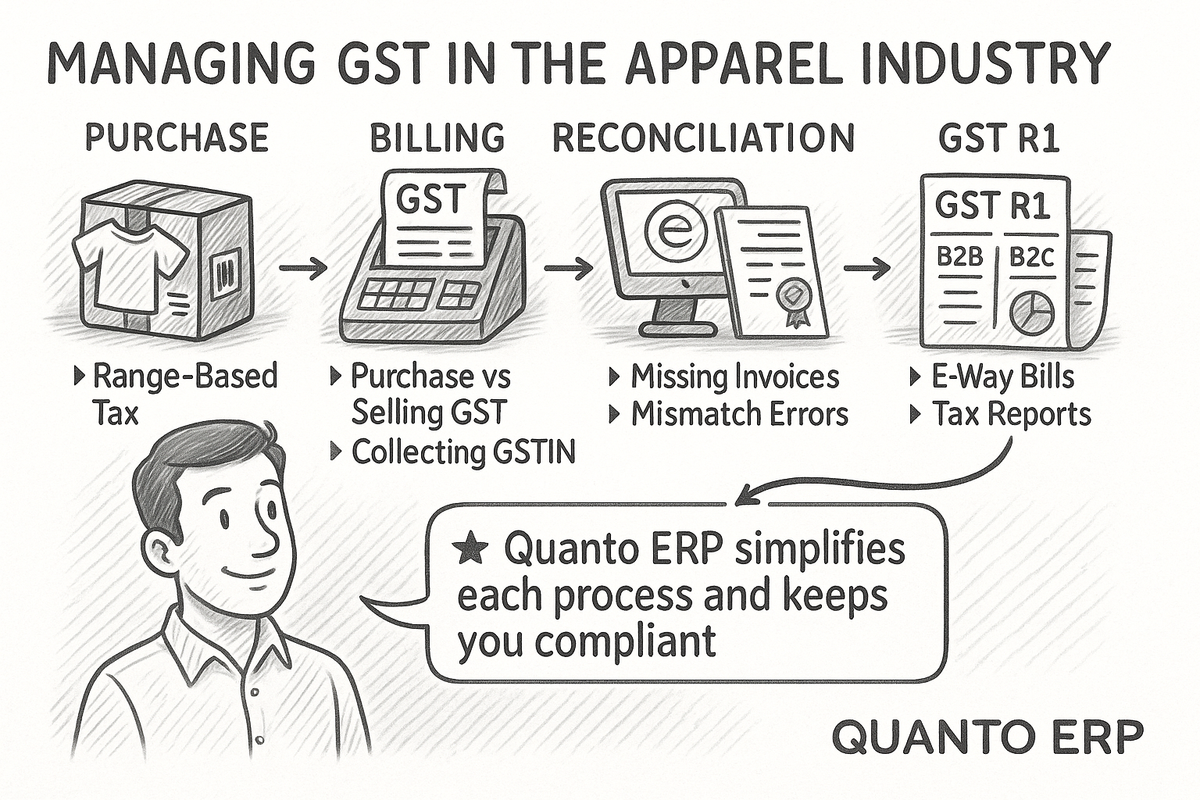
Apparel retail in India is one of the most heavily regulated segments under GST. From range-based taxation to reconciliation headaches, retailers spend as much time worrying about compliance as they do about sales.
In this article, we break down the most common GST challenges in the apparel industry — and how retailers can simplify them using modern ERP systems like Quanto.
🔹 1. Range-Based Tax Rates – The Apparel Confusion
One of the biggest pain points in apparel GST is the range-based tax structure.
- Until now:
- Garments up to ₹1,000 = 5% GST
- Garments above ₹1,000 = 12% GST
- Upcoming changes (announced):
- Garments up to ₹2,500 = 5% GST
- Garments above ₹2,500 = 18% GST
Why this is a problem:
- The same product can fall under two slabs just because of price.
- Example: A kurta priced ₹980 = 5% GST, but the same kurta priced ₹1,020 = 12% (soon 18%).
- This complicates billing, pricing strategies, and customer communication.
Solution:
ERP systems auto-apply tax slabs based on item value, reducing billing errors and disputes.
🔹 2. Purchase GST vs. Selling GST
In apparel, purchase GST and selling GST often don’t match because of discounts or promotions.
- Example: Retailer buys a shirt at ₹1,200 (12% GST).
- Later, sells it at ₹950 (5% GST slab).
Impact:
- ITC (Input Tax Credit) mismatch.
- Retailers must reconcile tax rate differences while claiming GST credits.
Solution:
ERP auto-calculates purchase GST vs selling GST differences and adjusts ITC claims accordingly.
🔹 3. GST 2B Reconciliation
The government requires businesses to reconcile purchase invoices (GSTR-2B) with their ITC claims.
Common Problems:
- Invoice numbers don’t match (supplier entered differently).
- Tax amounts mismatch.
- Missing invoices not uploaded by supplier.
Solution:
ERP reconciliation tools automatically match supplier invoices with books, flag mismatches, and prevent wrongful ITC claims.
🔹 4. GST Billing at the Sales Counter
Retailers face long queues, and GST billing can slow things down. Traditionally, GST bills are generated offline and processed later.
Solution:
- Collect customer GSTIN directly at the sales counter.
- Auto-generate GST invoice instantly.
- Avoid offline processes and reduce manual errors.
🔹 5. E-Invoice Generation at the Delivery Desk
For larger B2B or wholesale apparel retailers, e-invoicing is mandatory. Manually uploading invoices to GST portal is time-consuming.
Solution:
ERP integrates with GST APIs to auto-generate e-invoices at the delivery desk, in real time.
🔹 6. E-Way Bills, Debit Notes & Goods Movement
Any goods movement above ₹50,000 requires an e-way bill.
Retailers often forget to generate these or struggle with debit note adjustments.
Solution:
- ERP auto-prepares e-way bills during delivery/transfer.
- Debit notes can be tagged to invoices, avoiding reconciliation issues later.
🔹 7. GST R1 Reporting
The toughest part for apparel retailers is GSTR-1 filing, which requires detailed reporting:
- B2C tax-wise sales
- B2C large invoices
- Export invoices
- Credit notes
- B2B invoice-wise details
- HSN-wise summary for B2B and B2C
Solution:
ERP compiles all this automatically. Instead of manually entering hundreds of invoices, one click generates the complete GSTR-1 file, ready for upload.
🔹 8. Margin Calculation – With or Without GST
Another overlooked challenge in apparel retail is how margins are calculated in relation to GST.
- Case 1: Margin Includes GST
Some retailers include both purchase tax and sales tax in the margin calculation. For example:- Purchase = ₹1,000 + 5% GST = ₹1,050
- Sale = ₹1,500 + 5% GST = ₹1,575
- Margin = (₹1,575 – ₹1,050) = ₹525
- Case 2: Margin Excludes GST
Other retailers prefer to calculate only on the base value, ignoring tax:- Purchase = ₹1,000 (base)
- Sale = ₹1,500 (base)
- Margin = ₹500 (ignoring GST input/output).
Why this matters:
- Two retailers can look at the same transaction and record different margins.
- This affects pricing strategy, discount planning, and financial reporting.
Solution:
A good ERP must support both methods of margin calculation. Quanto ERP allows retailers to choose whether margins should be tax-inclusive or tax-exclusive, ensuring flexibility and accuracy for different accounting practices.
📊 Why GST is Tougher in Apparel
- Range-based slabs → complicated pricing.
- Seasonal spikes → large volumes, more invoices.
- Frequent discounts → mismatch between purchase/selling GST.
- Multiple suppliers from different states → ITC reconciliation issues.
🚀 Takeaway
GST is not going away — but the pain of managing it can. For apparel retailers, compliance is as important as customer service. An ERP designed for retail, like Quanto, automates:
- Tax slab application
- ITC reconciliation
- GST billing & e-invoices
- E-way bill generation
- Full GSTR-1 reporting
- Flexible margin calculation (with or without GST)
👉 Instead of wasting hours on compliance, retailers can focus on what matters: selling smarter and earning higher margins.
✨ End line: “GST is complex. With the right system, it doesn’t have to be complicated.”