Smart Purchase Planning for Family-Run Apparel Stores
Purchasing is the backbone of apparel retail. For a family-run store, it is often handled by one or two people — usually the owner or senior family members. While instinct and experience play a role, relying only on gut feeling can lead to overstock, stockouts, and locked capital.
A structured purchase plan helps retailers buy the right products, at the right time, in the right quantity. This ensures shelves remain fresh, customers always find what they want, and capital keeps rotating.
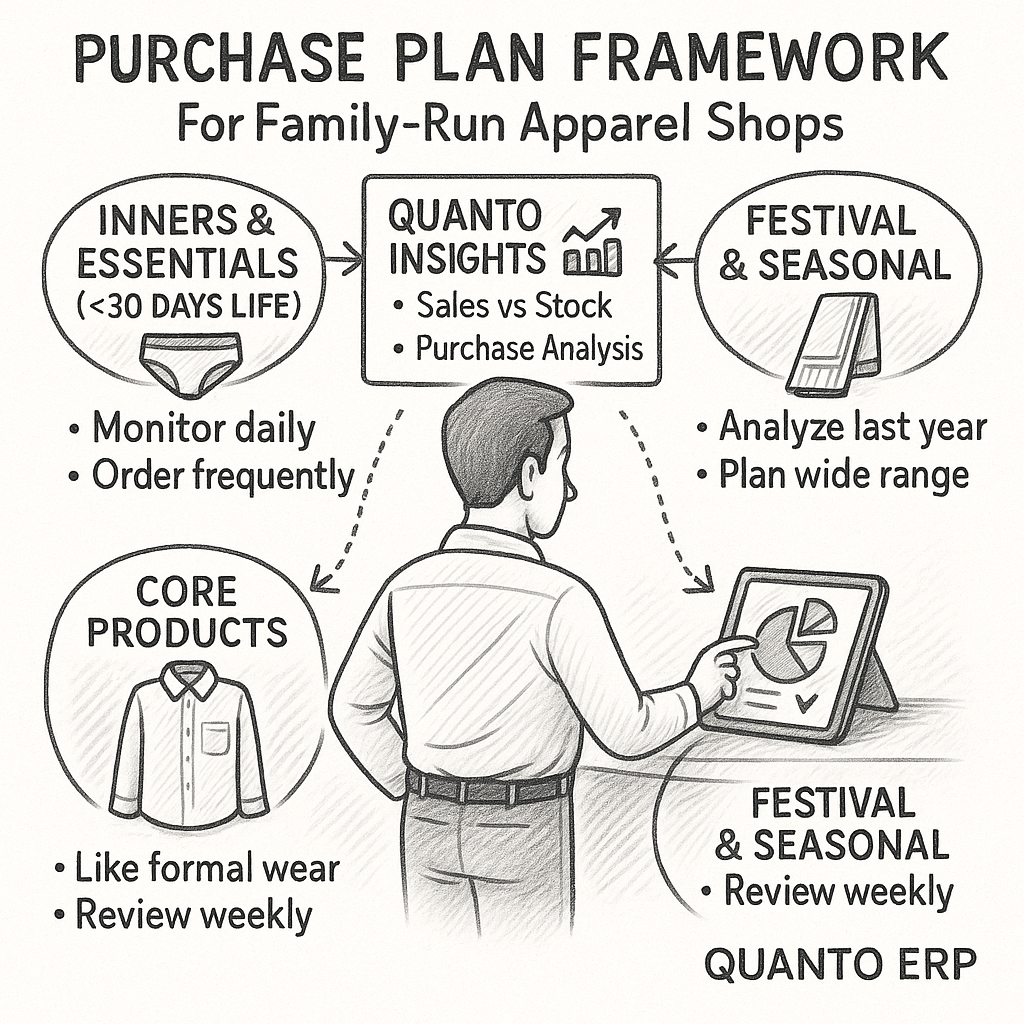
In this article, we’ll explore how to design a purchase plan tailored for family-run apparel shops. We’ll break it down into categories of products, seasonality, and ERP-driven insights from Quanto.
📌 1. The Three Layers of Purchase Planning
A. Inners & Essentials (Short Shelf Life Items)
- Items like inners, socks, and basic essentials have shelf lives <30 days.
- They move faster, and customers expect consistent availability.
- Purchase Mechanism:
- Monitor sales daily.
- Issue purchase orders every alternate day or once a week.
- Keep buffer stock for 7–10 days max to avoid excess tying up capital.
Example: A family store in Salem saw that men’s inners sold 50 packs per day. With 300 packs in stock, they had only 6 days of coverage. Their purchase plan triggered a new PO mid-week to avoid stockouts.
B. Core Products (Formal & Daily Wear)
- These are products that sell throughout the year: formal shirts, trousers, sarees, school uniforms.
- Demand is steady, not seasonal.
- Purchase Mechanism:
- Monitor weekly or fortnightly.
- Restock based on sales velocity and supplier lead times.
- Focus on consistent quality and price stability, since these build customer trust.
Example: A Chennai retailer tracks weekly sales of formal shirts by size. They found M and L sizes moved fastest. Their purchase plan ensured these sizes were replenished every 2 weeks, while XS and XXL were ordered less frequently.
C. Festival & Seasonal Products
- These are high-risk, high-reward items: Diwali kurtas, Pongal sarees, Christmas party wear.
- Demand spikes sharply, but only for a limited period.
- Purchase Mechanism:
- Analyze last year’s sales by category, color, and size.
- Place orders 60–90 days before the season.
- Diversify across designs, suppliers, sourcing cities, and price ranges.
- Avoid overbuying premium pieces — focus on fast-moving designs.
Example: For Diwali, a retailer in Madurai used last year’s data: blue and maroon kurtas sold fastest, while green lagged. They adjusted their 2024 order to focus 40% on the top two colors, avoiding dead stock in slow sellers.
📊 2. Quanto Insights for Smarter Purchase Decisions
Family retailers don’t need to guess. Quanto ERP offers reports that simulate demand and highlight purchase needs:
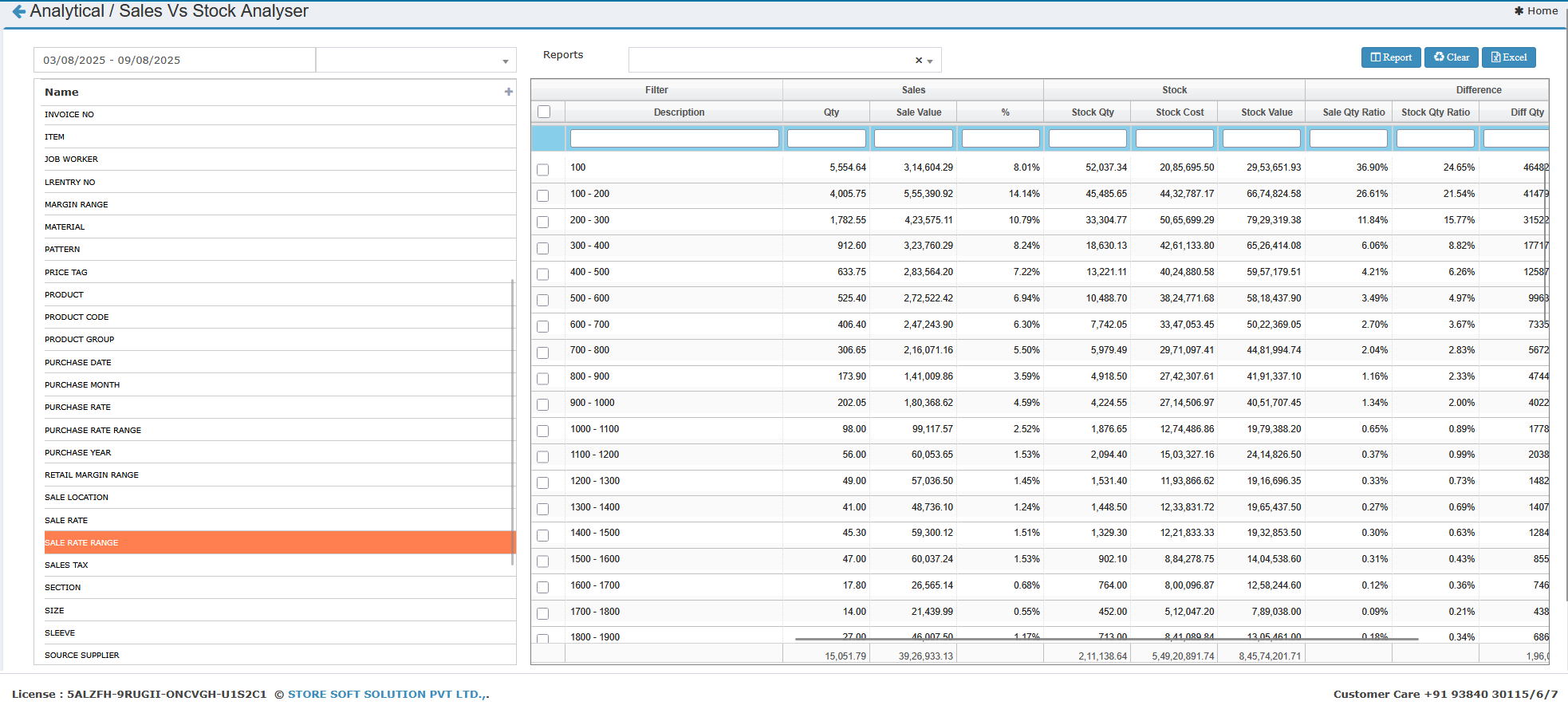
Sales vs Stock Analysis
- Compares past sales patterns with current stock availability.
- Example: Last year, the first week of August saw 500 saree sales. Current stock = 300. The system highlights a 200-piece gap and auto-suggests a purchase order.
- Can be filtered by:
- Price range
- Supplier
- Design
- Color
- Size
👉 This prevents surprises when seasonal spikes repeat.
Purchase Analysis
- Focuses on new designs or recently purchased products.
- If new items are selling faster than expected, the system highlights risk of stockout next week.
- Example: A new kurta design sells 50 pieces in 3 days. Current stock = 200. At this rate, it will be out in 12 days. The ERP recommends reordering immediately to avoid losing momentum.
👉 This ensures you never lose sales on trending products.
🛠 3. Building a Practical Purchase Mechanism
Here’s how a family-run shop can implement daily, weekly, and seasonal purchase planning:
Daily
- Track inners, basics, and short-life items.
- Issue small, frequent POs (alternate day or weekly).
Weekly/Fortnightly
- Review sales vs stock for core products.
- Reorder steady sellers in balanced ratios (sizes/colors).
Seasonal/Festival
- Review past year’s seasonal sales.
- Plan 2–3 months in advance.
- Diversify supplier base to reduce dependency.
- Allocate 20–30% of budget to new trends each season.
⚠️ Common Mistakes in Purchase Planning
- Overbuying seasonal designs → Leads to heavy discounts later.
- Ignoring sizes → Stocking designs but missing popular M/L sizes.
- Supplier dependency → Relying on one supplier limits variety.
- No buffer for fast-movers → Missing sales during demand peaks.
- Confusing cash flow with profit → Buying too much stock ties up working capital.
📊 Real Case Story
A family-run retailer in Erode ran into issues every Diwali: leftover stock worth ₹15 lakhs. After implementing structured purchase planning with Quanto:
- They cut seasonal overbuying by 20%.
- Reordered fast-moving kurtas mid-season.
- Reduced dead stock by 40%.
- Freed up ₹8 lakhs in capital for new designs.
🚀 Takeaway
A purchase plan is not about buying less — it’s about buying smart.
- Inners: monitor daily, buy frequently in small lots.
- Core Products: steady reorders keep customers satisfied.
- Seasonal Products: data-driven buying avoids risk and maximizes sales.
- ERP Insights: Quanto’s Sales vs Stock and Purchase Analysis reports replace guesswork with data.
👉 For family-run apparel shops, structured purchasing is the difference between surviving season to season and building a profitable, long-term retail brand.
✨ End line: “Sales happen on the shop floor, but profits are made at the purchase counter.”