
Smart Q&A for Apparel Retailers
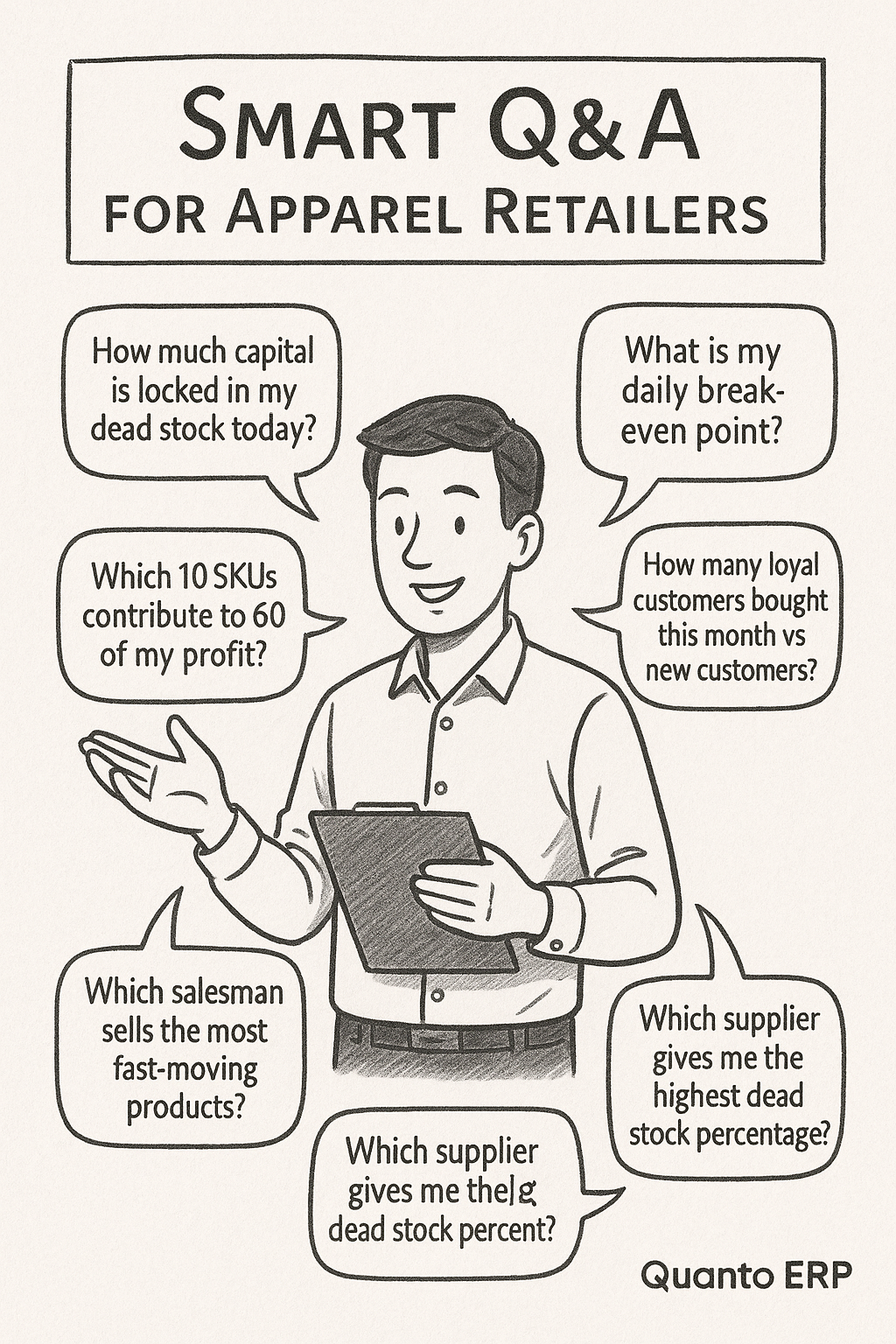
1. For an apparel retailer, what are the most important things the owner should focus on?
Answer:
- Right product mix (designs, sizes, price ranges).
- Strong cash flow control (collections vs expenses).
- Customer satisfaction (availability, service, loyalty).
- Staff performance and motivation.
- Regular monitoring of KPIs (gross margin, stock rotation, dead stock).
2. How to purchase the right product at the right price range?
Answer:
- Analyze past sales → see which designs, sizes, and price bands sold fastest.
- Study your customer base → students, families, or premium buyers.
- Negotiate with vendors for bulk discounts but avoid overstocking.
- Always keep 3 balanced ranges: Budget, Mid, Premium.
3. How to fix product margins and discounts?
Answer:
- Fix a base margin per category (e.g., 35% shirts, 40% sarees).
- Keep a planned discount buffer (10–15%).
- Use discounts only for dead stock or festivals, not for fresh arrivals.
- Protect margins by offering bundles instead of flat price cuts.
4. How to find the optimal stock for each product and price range?
Answer:
- Use past sales history → calculate average sales per month.
- Apply safety stock (20–25% extra for fast movers).
- Set reorder levels by category and size.
- Avoid equal splits across all sizes; keep a healthy size ratio.
5. How to increase customer walk-ins?
Answer:
- Run festive promotions and loyalty offers.
- Use WhatsApp campaigns with new arrivals.
- Partner with local events and advertise through influencers.
- Keep storefronts attractive and updated weekly.
6. How to increase basket size of sales?
Answer:
- Bundle products: shirt + trouser, saree + blouse.
- Train sales staff to suggest add-ons (belt, dupatta, tie).
- Offer combo discounts (“Buy 2 Get 1”).
- Display complementary products together.
7. How to avoid old-age stock?
Answer:
- Monitor stock age → anything 2× average is “dead stock.”
- Rotate slow movers between branches.
- Bundle with fast movers.
- Run clearance offers quarterly, not just end-of-season.
8. What are the best ways to provide promotional offers?
Answer:
- Festival sales with controlled discounts.
- Bundle offers (Buy 1 Get 2, Buy 2 Get 1).
- Loyalty-based offers (extra points on weekdays).
- Targeted WhatsApp campaigns instead of mass SMS.
9. How to make customers return again and again?
Answer:
- Loyalty programs with redeemable points.
- Notify customers of new arrivals through WhatsApp.
- Offer personalized recommendations based on past purchases.
- Build trust with hassle-free exchanges at any branch.
10. How to monitor sales performance?
Answer:
- Daily dashboards: sales by category, section, and price range.
- Compare actual sales vs monthly targets.
- Track gross margin %, not just total sales.
11. How to monitor stock at section level with price range?
Answer:
- Reports showing stock split by section (men, women, kids).
- Track which price bands in each section sell faster.
- Identify dead stock at section + price range level.
12. How to monitor salesman performance?
Answer:
- Bill count per salesman.
- Sales value and average bill size.
- Contribution to fast movers vs dead stock.
- Customer feedback or repeat sales linked to each staff.
13. What incentive mechanisms work for salesmen?
Answer:
- Sales-based incentives (target achievement bonuses).
- Product-specific incentives (extra for clearing dead stock).
- Team incentives for overall store performance.
- Loyalty-linked → bonus for repeat customers handled.
14. How to plan vendor payments?
Answer:
- Map vendor due dates against daily cash flow.
- Prioritize vendors with fast-moving products.
- Use ERP reminders to avoid penalties.
- Negotiate credit terms to match stock rotation speed.
15. How to know if you are profitable for the day?
Answer:
- Compare sales vs cost of goods sold vs expenses.
- Track daily gross margin % (not just collections).
- Watch cash vs credit → profit without collection = risk.
16. How to predict if your sales rotation is on track?
Answer:
- Measure stock turnover ratio (average stock sold in 45–60 days).
- If stock age is rising → rotation is slowing.
- Daily vs target dashboard shows whether you are pacing ahead or behind.
17. How to confirm you have optimum stock daily?
Answer:
- Run ERP low-stock alerts for core products.
- Maintain minimum-maximum stock levels by category.
- Daily morning check → winners and essentials must always be available.