
The Price of Ignoring KPIs – Why Apparel Retailers Can’t Afford to Fly Blind
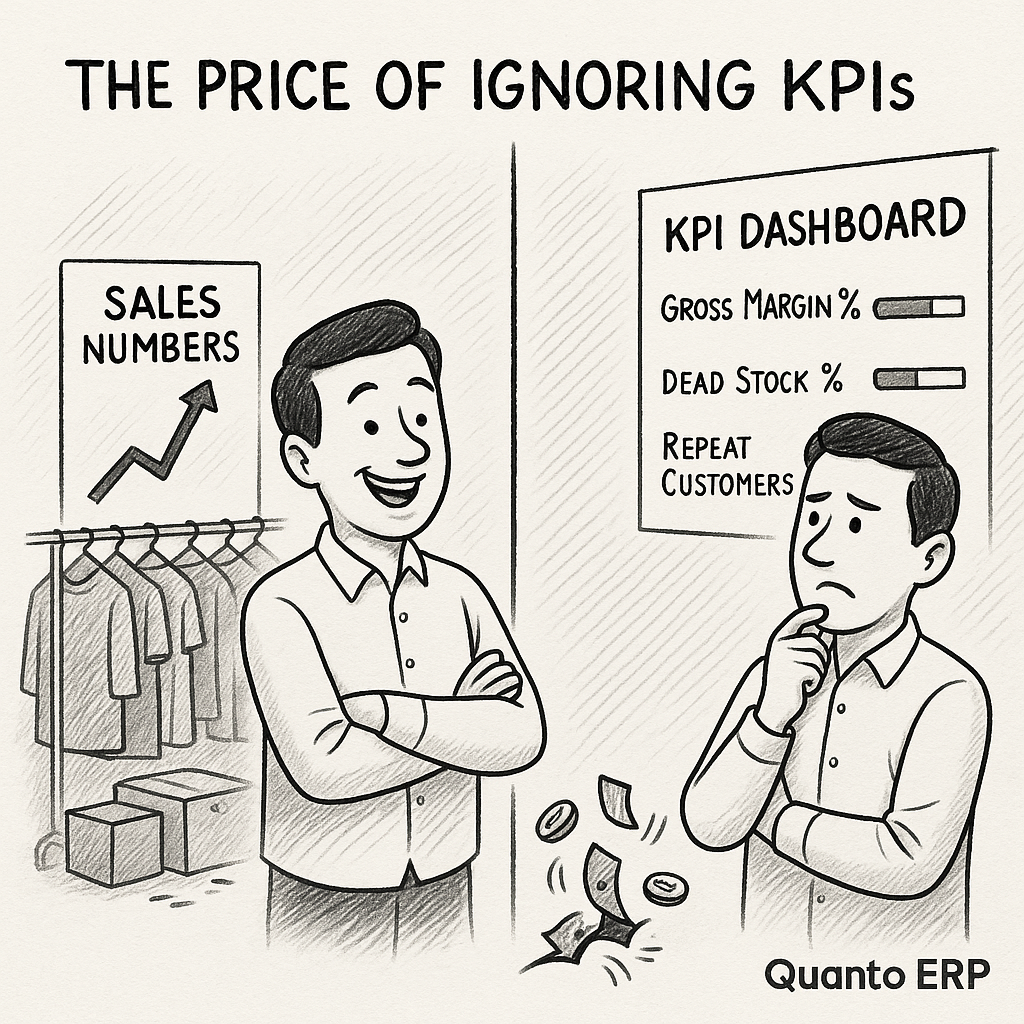
Apparel retail is a high-volume, fast-moving, and margin-sensitive business. Owners often focus on sales numbers alone — how much came in today, this week, or this month. But sales are only the tip of the iceberg. Beneath the surface lie critical metrics — Key Performance Indicators (KPIs) — that reveal the true health of your business.
Ignoring these KPIs is like driving with your eyes closed. You may be moving, but you won’t see the turns, the bumps, or the accidents until it’s too late.
📊 The Critical KPIs for Apparel Retail
- Sell-Through Rate
- Definition: Percentage of stock sold compared to stock purchased.
- Why It Matters: If you sell only 50% of what you buy, your warehouse becomes a dead-stock graveyard.
- Example: You ordered 1,000 shirts. If only 600 sold in 90 days, your sell-through rate is 60%. Without action, 400 shirts tie up capital and space.
- Basket Size (Average Bill Value)
- Customers who buy one shirt are valuable. Customers who buy a shirt + trousers + accessories are more profitable.
- Tracking basket size helps measure cross-selling success and create bundle offers.
- Discount Dependency
- If more than 40% of your sales happen only during discounts, it’s a warning sign. You’re not selling products — you’re selling price cuts.
- High discount dependency kills margins and trains customers to wait for sales.
- Stock Age
- Every product has a shelf life. Items that don’t move within the expected time turn into dead stock.
- KPI: Average stock age should be healthy (e.g., <60 days for apparel). Anything beyond 2× that should trigger clearance campaigns.
- Return Rate %
- Returns silently eat profit.
- Measuring why customers return items (wrong fit, quality issues, misleading info) helps fix root causes.
⚠️ The Real Cost of Ignoring KPIs
- Capital Lock: You believe you’re profitable because sales are steady, but ₹10 lakhs of stock sits unsold in storage.
- Margin Erosion: Heavy discounts look like great sales days, but margins shrink below survival levels.
- Customer Frustration: Without tracking size/color patterns, customers repeatedly face stockouts of popular options.
- Risky Expansion: Opening a new store without understanding KPIs multiplies problems instead of profits.
Example Case
- Store A sells ₹20 lakhs a month but ignores KPIs.
- Basket size drops.
- Discount dependency grows to 50%.
- Dead stock crosses ₹5 lakhs.
- Result: Net profit = only 6%.
- Store B also sells ₹20 lakhs but tracks KPIs.
- Introduces bundle offers to lift basket size.
- Reduces discount reliance by 15%.
- Clears dead stock through quarterly promotions.
- Result: Net profit = 14%.
That’s the difference between surviving and thriving.
✅ How to Bring KPIs Into Daily Retail
- Dashboard Monitoring: A live ERP dashboard that shows sell-through, basket size, and discount percentage daily.
- Automated Alerts: Notifications when stock crosses age limits or when discount sales exceed safe thresholds.
- Section-wise Reporting: See which category (men’s, women’s, kids) is truly driving profit.
- Staff Incentives: Link employee performance to KPI improvements, not just raw sales numbers.
🚀 Takeaway
Apparel retail is too complex to run on guesswork. Sales figures alone are misleading. KPIs are the true compass of your business — showing where you’re gaining, where you’re bleeding, and where to act immediately.
👉 Retailers who ignore KPIs end up with shrinking margins, dead stock, and frustrated customers.
👉 Retailers who measure them consistently build predictable, repeatable, and profitable businesses.
✨ End line: “Sales show movement. KPIs show direction. Ignore them, and you risk going nowhere.”