
The Retail Life Cycle – Understanding the Pulse of Apparel Stores
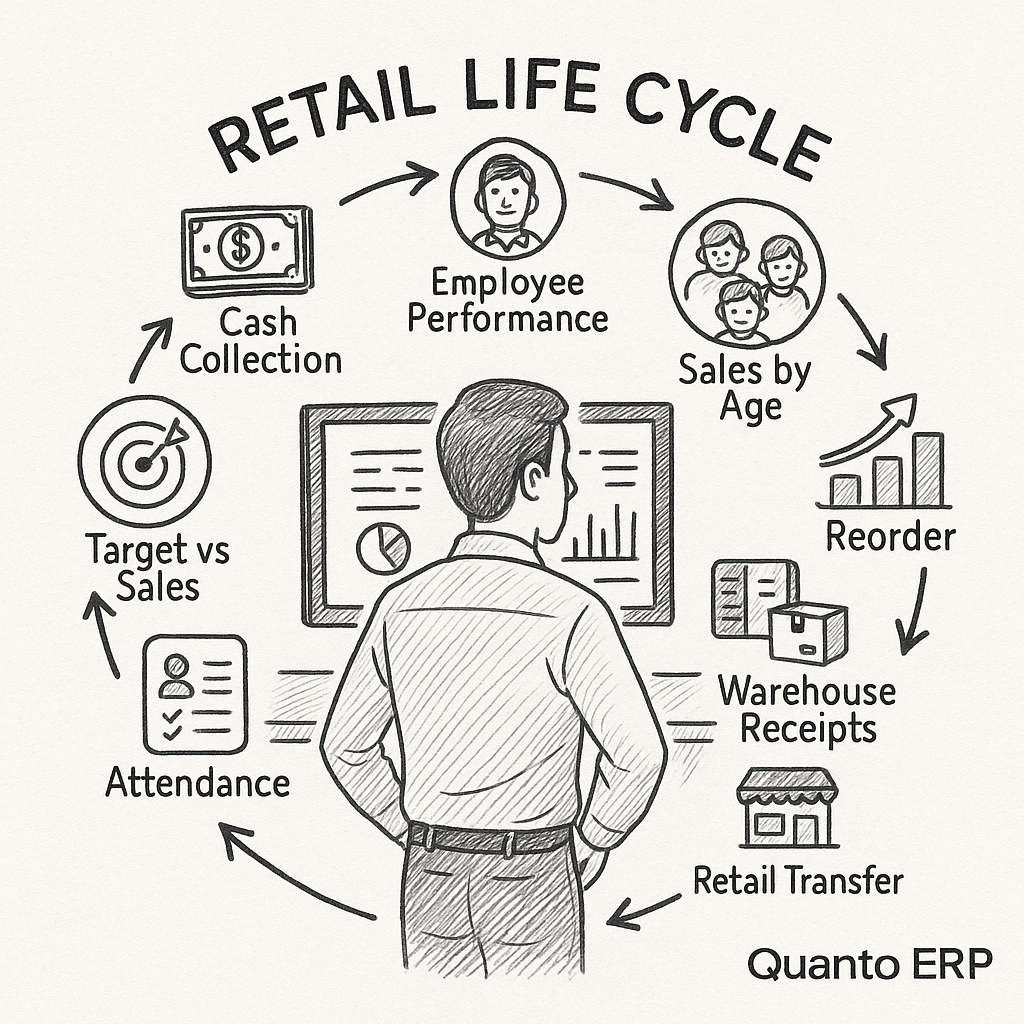
Every retailer knows that business is not just about buying and selling. It’s about keeping the store alive — ensuring that every process, from purchasing to sales to staff performance, flows smoothly. This flow is what we call the Retail Life Cycle.
Unlike FMCG, where demand is relatively steady and predictable, apparel retail is volatile and multi-layered. Sizes, colors, styles, and seasonal demands make planning a daily challenge. By tracking the retail life cycle step by step, store owners can stay ahead of surprises, reduce dead stock, and keep profits consistent.
🔄 Step 1: Employee Performance
Retail is run by people. How your sales team greets a customer, how fast they respond, and how they convert interest into sales — all of this defines store performance. Poor employee engagement translates into lost sales opportunities.
- Measure individual sales contribution.
- Track conversion ratios (walk-in vs. billed customers).
- Recognize and reward high performers, while training others.
When performance data is visible, accountability improves, and the team works toward common targets.
🧑🤝🧑 Step 2: Sales by Age
Not every product sells equally. A kurta that arrived last week moves fast, while one that has been on the shelf for 90+ days becomes harder to sell. By analyzing sales by stock age, retailers can:
- Identify fast-moving designs and reorder before they sell out.
- Flag slow movers before they become dead stock.
- Spot seasonal buying patterns.
This gives clarity on which designs deserve investment and which need clearance.
📦 Step 3: Reorder
Reordering is where money is either multiplied or wasted. Retailers often reorder purely on gut feeling — “this shirt sold well last month, let’s buy 200 more.” But smart reordering relies on data:
- Which sizes sold fastest?
- Which price ranges moved well?
- Which colors had higher return rates?
The life cycle teaches us to reorder only after analyzing sales patterns, not assumptions.
🏬 Step 4: Warehouse Receipts & Transfers
Inventory doesn’t stay at the warehouse forever. It moves.
- Receipts → New stock arrives.
- Transfers → Stock is moved from warehouse to store or between branches.
Errors here create nightmares: a store may be sitting on excess L sizes while another store is out of stock. A centralized ERP ensures accurate receipts and smooth transfers so every outlet has what customers need.
🛒 Step 5: Retail Transfer & Shelf Flow
Stock at the back is wasted stock. A strong cycle ensures quick shelf transfer so customers always see new designs on display. Stale stock should rotate out, either to other branches or to clearance bins, before it blocks space for new arrivals.
✅ Step 6: Attendance & Targets
Retail is a human-driven business. Daily attendance impacts sales directly. If peak hours have fewer staff, customer service suffers. By linking attendance with sales targets, retailers can:
- Forecast manpower needs during festivals or weekends.
- Measure efficiency (sales per staff per day).
- Build fair incentive systems.
🎯 Step 7: Target vs. Sales
Every retail cycle must loop back to the target.
- Did we achieve 100% of the daily sales target?
- Which section (men’s, women’s, kids’) underperformed?
- Are discounts driving sales or killing margins?
Without this review, retailers only “know” numbers at month end — when it’s too late to react. Real-time comparison helps correct mistakes on the go.
💰 Step 8: Cash Collection
At the end of the cycle, it’s not just about sales — it’s about cash in hand. Credit sales, pending UPI settlements, and uncollected dues often shrink actual liquidity. Tracking collections daily closes the loop and ensures healthy cash flow.
📊 Why This Cycle Matters
Retailers who ignore the life cycle end up with broken processes: staff underperforming, shelves cluttered with old stock, uneven transfers, and cash stuck in receivables.
Retailers who monitor the cycle through ERP dashboards enjoy:
- Faster stock rotation.
- Lower dead stock levels.
- Transparent staff performance.
- Steady cash flow.
🚀 Takeaway
The Retail Life Cycle is not just theory — it’s the backbone of apparel business success. From employee performance to sales by age, from reordering to cash collection, each step influences the next.
👉 Retailers who understand this cycle gain clarity, discipline, and higher profitability.
👉 Retailers who ignore it are left fighting fires every day.
With Quanto ERP, the entire cycle becomes visible on one screen, empowering owners to take decisions that are timely, data-driven, and profitable.
✨ End line: “Retail is not just sales — it’s a cycle. Master it, and you master your business.”