
Why Apparel is So Special
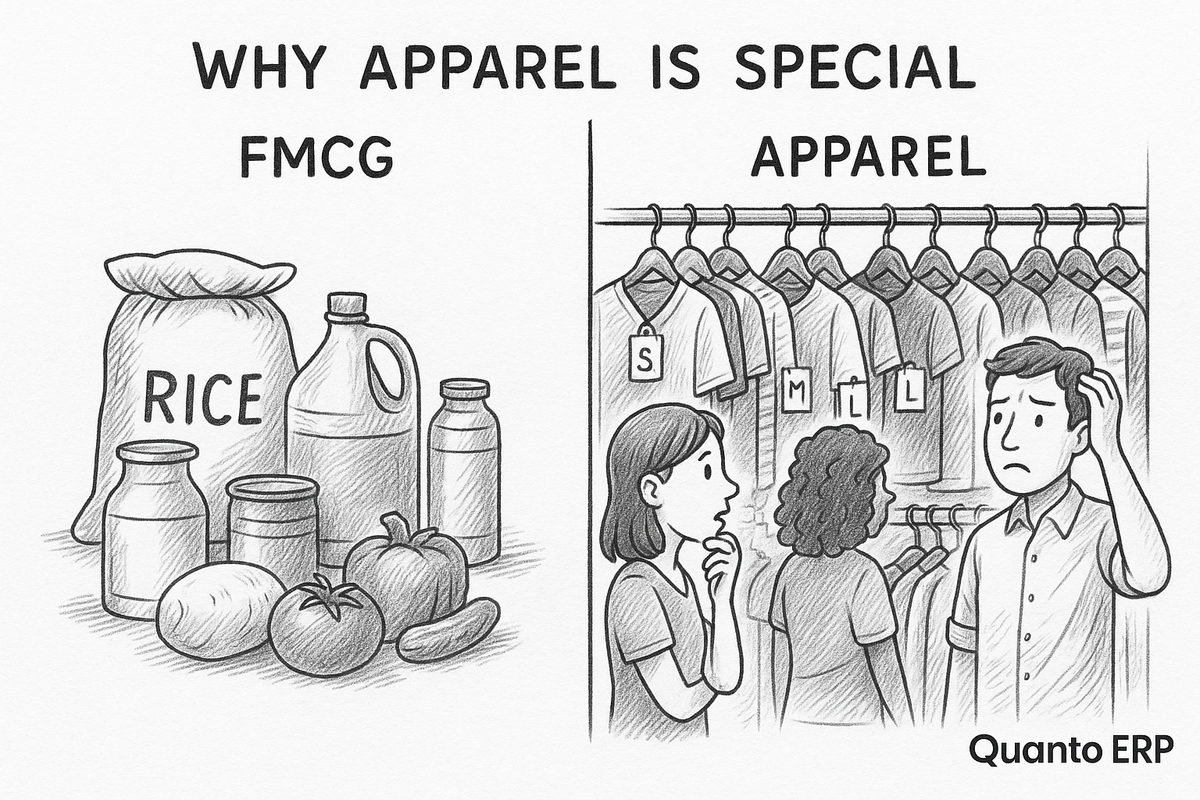
Every retailer knows that selling groceries or FMCG (fast-moving consumer goods) is about predictable demand. Rice, oil, sugar, and vegetables have steady consumption. If you sold 100 kg of rice last month, you can expect to sell something close this month too.
But apparel? It plays by a completely different set of rules. In fact, 75% of apparel demand is unpredictable. That unpredictability makes the apparel business both exciting and challenging — and it’s what makes apparel retail so special.
📦 FMCG vs. Apparel: A Tale of Predictability
FMCG (Predictable Demand)
- 90% predictable → If customers buy Colgate this week, they’ll likely buy Colgate next week.
- Only 10% risk → New flavors, seasonal products, or promotions.
- Consumption-driven → Everyone needs food, groceries, and daily items.
Apparel (Unpredictable Demand)
- Only 25% predictable → School uniforms, basic whites/blacks, everyday innerwear.
- 75% unpredictable → Seasonal fashion, trends, personal tastes, and new arrivals.
- Choice-driven → Customers buy what they like, not just what they need.
👕 Why Apparel Is Complicated
Unlike FMCG, where demand is about stock level, apparel combines multiple attributes:
- Size (S, M, L, XL, XXL)
- Color (black, white, seasonal shades)
- Material (cotton, polyester, blends)
- Sleeve (full, half, ¾)
- Fit (regular, slim, comfort)
- Price Range (budget vs premium)
- Brand Preference
That means one simple item — a shirt — could have dozens of combinations. Predicting what will sell from this matrix is a puzzle every retailer must solve.
📊 The Risk of Guesswork
Without data, retailers often rely on gut feeling:
- “White shirts always sell.”
- “M and L sizes move fastest.”
- “Festive season = more kurta sales.”
While these may be true, they are not complete truths. A bad guess can lead to:
- Overstock of unpopular colors/sizes → dead capital.
- Stockouts of fast-moving combinations → lost sales.
- Frustrated customers who leave without buying.
🎯 Why This Unpredictability Is Actually an Opportunity
Here’s the secret: what makes apparel risky also makes it profitable.
- Higher margins than FMCG → because of uniqueness.
- Impulse buying → customers don’t just buy what they need, but what excites them.
- Differentiation → the right collection makes a store stand out from competitors.
While FMCG retailers fight over tiny margins on rice and sugar, apparel retailers can command premium prices by offering the right mix of style, size, and fit.
🛠 How Retailers Can Tame Apparel’s Complexity
The answer isn’t guessing harder — it’s tracking smarter.
- Analyze Past Sales → Which sizes/colors sell fastest?
- Segment by Price Range → Budget vs premium customers.
- Seasonal Patterns → Festival spikes, school reopening, wedding season.
- Dead Stock Alerts → Stop reordering slow movers.
- Customer Preferences → Loyalty profiles to see who buys what.
By turning unpredictability into data-driven insights, apparel retailers can cut risk while increasing sales.
💡 A Real Example
One retailer stocked 500 shirts in random ratios (equal splits of sizes/colors). Result:
- M & L in white and blue sold out in 2 weeks.
- XS, XXL, and odd colors stayed unsold for 6 months.
- Capital locked = ₹2 lakhs.
Another retailer used ERP insights:
- Ordered 60% in M/L, 20% in S/XL, 20% in premium colors.
- Result: 90% sell-through within 6 weeks.
- Capital rotated faster, freeing money for new designs.
🚀 Takeaway
Apparel is special because it combines art + unpredictability + margin.
- It’s harder than FMCG, but also far more rewarding.
- The very complexity of apparel — sizes, fits, styles, trends — is what makes it profitable when managed right.
- Retailers who understand this unpredictability and embrace data-driven tools will always have an edge.
✨ In FMCG, demand follows supply. In apparel, demand follows imagination.
That’s why apparel is — and will always remain — a special retail category.